Palisades Park NJ Home Prices: Why 2026 Reports Disagree
September 17, 2026
September 17, 2026
Pull two market reports on Palisades Park this summer and you'll find two different towns. One says home prices dipped slightly over the last quarter and are selling faster than they did a year ago. The other says prices jumped double digits over the same stretch and homes are sitting on the market three times longer. Same borough. Same zip code. Same few months of 2026. The numbers shouldn't be able to disagree this much, and yet they do.
The disagreement isn't a data error. It's a symptom. Palisades Park doesn't have one housing market. It has at least three, stacked into a single square mile, and whichever slice of inventory happens to trade in a given month decides which story the aggregate number tells.
Here's what the conflicting summaries actually show for roughly the same window in 2026:
| Metric | Report A (three months ending ~June 2026) | Report B (same general period) |
|---|---|---|
| Median sale price | $1.0M, down about 0.5% year over year | $1.04M, up 11.8% year over year |
| Average days on market | 79 days (down from 121 a year prior) | 140 days |
| Market read | "Somewhat competitive," some multiple offers | "Leaning buyer's," about 7 months of supply |
A buyer skimming headlines could walk away thinking Palisades Park is either a fast-moving seller's market or a slow buyer's market, depending on which link they clicked first. Both readings are drawn from real closed sales. Neither is wrong. They're just averaging different things.
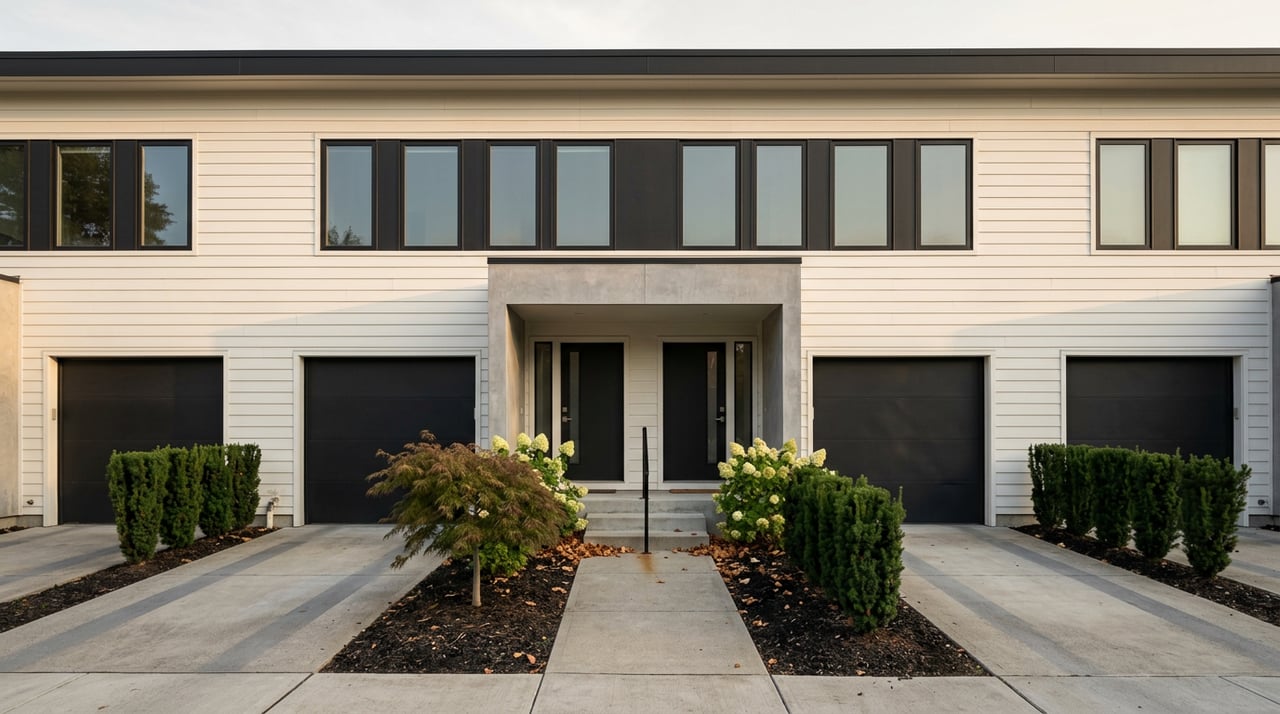
Palisades Park's housing stock isn't uniform the way a planned subdivision is. Walk a few blocks in any direction and the building type changes under your feet: postwar two-and-three-family homes from the 1940s through 1960s, older single-family cottages that predate 1940, teardown-rebuild duplexes that have replaced older lots at a steady pace since 2000, and mid-rise or high-rise condo buildings mixed in along the busier corridors. Roughly a third of the borough's housing falls into that first postwar category, another meaningful share is small two-to-four-unit buildings, and a separate slice is condo product. No single one of those categories is "the market." All of them close in the same MLS feed and get averaged into the same monthly median.
That means a month heavy on new-construction duplex sales will push the median and the price-per-square-foot up, because those units sell at a premium and appraise differently than a 1958 two-family. A month heavy on older multi-family resales or a slower condo stretch will drag the same median down and stretch out the days-on-market average, because that inventory typically takes longer to find a buyer. The "median home price in Palisades Park" is less a single fact and more a rolling average of three different products taking turns being the loudest voice in the room.
The duplex-rebuild segment deserves a closer look, because it's the piece most likely to explain a sudden appreciation swing. Palisades Park's zoning code puts firm limits on what a new duplex can be: the foundation footprint cannot exceed 2,500 square feet regardless of the size of the lot it sits on, the maximum building height is 28 feet measured to the average roofline, and the home must include two two-car garages, four enclosed spaces total, plus enough driveway width to bring total off-street parking to eight spaces when combined with the garages.
Those aren't cosmetic details. They're the reason a rebuilt duplex on a modest Palisades Park lot commands a real premium over the older two-family next door, and why that premium shows up unevenly depending on how many teardown-rebuild sales happen to close in a given quarter. A buyer comparing "Palisades Park" to a neighboring town on price per square foot alone is often really comparing a handful of new, code-maximized duplexes against an older, more varied housing stock somewhere else. The comparison only holds if you know which building type you're actually pricing.
The market's next reshaping is already approved and sitting on paper. In June 2026, the Palisades Park Planning Board approved The Grandline, a 510-unit mixed-use project on a 6.2-acre site at 21 Grand Avenue, bounded by West Ruby Avenue, Route 46, and Grand Avenue. The plan calls for two towers, 19 and 17 stories, developed by March Associates and designed by MHS Architecture, with 102 of the 510 units set aside as affordable housing. Beyond the residential towers, the approval includes a hotel, a wellness center, and a 175,000-square-foot two-story shopping plaza wrapped around a landscaped public esplanade, with Melillo Bauer Carman as landscape architect. The project reached approval through a builder's remedy settlement, and as of the June 2026 approval, no construction timeline had been announced.
For a borough where most existing housing tops out well short of high-rise, a project of this scale is the kind of thing that eventually rewrites what "median" means locally, simply by adding hundreds of units of a housing type that barely exists here today. It hasn't happened yet. There's no groundbreaking date on record, no unit pricing, no absorption data to fold into any median. But anyone comparing Palisades Park to other Bergen County towns on a five-year view should know it's coming, because a supply shock of this size doesn't quietly average itself into a monthly report. It shows up as a step change whenever it lands.
Underneath all of this, According to Appraisal Systems, Inc., Palisades Park just went through a full property reassessment for the 2026 tax year, with property values reset to their fair market value as of October 1, 2025. The reassessment firm's own projection put the new tax rate at $1.346 per $100 of assessed value, based on the prior year's tax levy and before accounting for any 2026 budget increases. That's worth sitting with for a second: the predicted rate is actually lower than the $1.405 per $100 figure the borough was projecting during its previous reassessment cycle. That's not a tax cut. It's what happens when assessed values rise across the board and the same levy gets spread over a larger base, so the rate itself can fall even as most individual bills go up.
According to Prodigy RE, Palisades Park was also one of twelve Bergen County municipalities, alongside towns like Edgewater, Paramus, and Cresskill, placed on a May 4, 2026 appeal deadline this year because of the reassessment. That window has closed. What that means for a buyer today isn't that there's an appeal to file. It means the assessed value attached to any current listing already reflects the new, post-reassessment number, not the older figures that a lot of general tax-rate comparisons for the borough are still built on. If you're underwriting a purchase using a tax-bill estimate that predates 2026, you're working from the wrong base year. Ask for the current assessment and apply the current predicted rate, not a average pulled from an older summary.
None of this makes Palisades Park harder to buy into. It makes it a town where the headline number needs a follow-up question. Before treating any median price, appreciation figure, or days-on-market stat as the whole story, ask which segment of the housing stock it's describing: an older two-family, a code-maximized new duplex, or condo inventory. Ask whether the assessment behind the listing predates the 2026 reassessment. And if you're thinking in five-year terms rather than five-month terms, factor in that a 510-unit project is already approved and will eventually add a housing type the current data has never had to account for.
Is Palisades Park currently a buyer's market or a seller's market? Depending on the source and the mix of homes that closed in a given month, it's been described both ways in 2026. The honest answer is that it depends heavily on which segment of housing stock, older multi-family, new duplex, or condo, dominated the sales sample that period.
Will The Grandline affect home values near it right away? As of its June 2026 approval, no construction start date had been announced, so there's no absorption or pricing data yet to reflect in current comparisons. Its effect on nearby values is a multi-year question, not a current-quarter one.
Does the 2026 reassessment mean my tax bill is finalized? The reassessment set new assessed values as of October 1, 2025, and produced a predicted rate of $1.346 per $100. The final rate still depends on county, school, and municipal budget approvals, so treat the predicted figure as a strong estimate rather than the last word.
Numbers this scattered are exactly why a local read matters more than a portal average. If you're weighing Palisades Park against another Bergen County town, or trying to figure out what a specific listing's assessment actually means for your carrying costs, Ridgeco Properties can walk through the current comps block by block. Get your free home valuation to start with real numbers instead of an average that's averaging the wrong things together.
This article is general information, not legal, tax or financial advice. Consult a qualified professional about your situation.
Stay up to date on the latest real estate trends.
With our knowledge and expertise in local trends of this ever-evolving market, we are dedicated to helping buyers and sellers alike.
RIDGECO PROPERTIES
RIDGECO PROPERTIES INC
613 Bergen Blvd
Ridgefield NJ 07650
